
Why CSR Events India Are Becoming a Powerful Branding Tool
In a media environment where every corporate communication is viewed with some scepticism, where consumers are quick to identify performative virtue and slow to forgive it, authenticity has become the rarest and most valuable brand asset of all.
CSR events India have quietly become one of the most potent tools for building exactly that — not because they are communications exercises, but because, when done well, they are genuine expressions of a company’s commitment to the communities it operates in. The brand benefit follows from the authenticity, not the other way around.
India’s mandatory CSR regime, established under Section 135 of the Companies Act 2013, has made social investment a permanent feature of the corporate calendar. But the move from grudging compliance to engaged, visible community action — from writing cheques to showing up — is a choice that companies are making for reasons that go well beyond regulatory obligation.
The data on why is clear: 76% of companies globally recognise that CSR is an effective tool for reducing brand reputation risk, and 77% of consumers prefer buying from companies that actively engage in CSR. In India’s competitive consumer and talent markets, these numbers translate directly into business outcomes.
What Makes CSR Events India Different from Other Brand Touchpoints?
Most corporate brand communications are one-directional. An advertisement tells consumers what a company wants them to believe. An annual report tells investors what a company has achieved. A press release tells journalists what a company wants them to report.
These are legitimate and necessary communications, but they are not experiences. They do not create memory, relationship, or trust in the way that a direct encounter does.
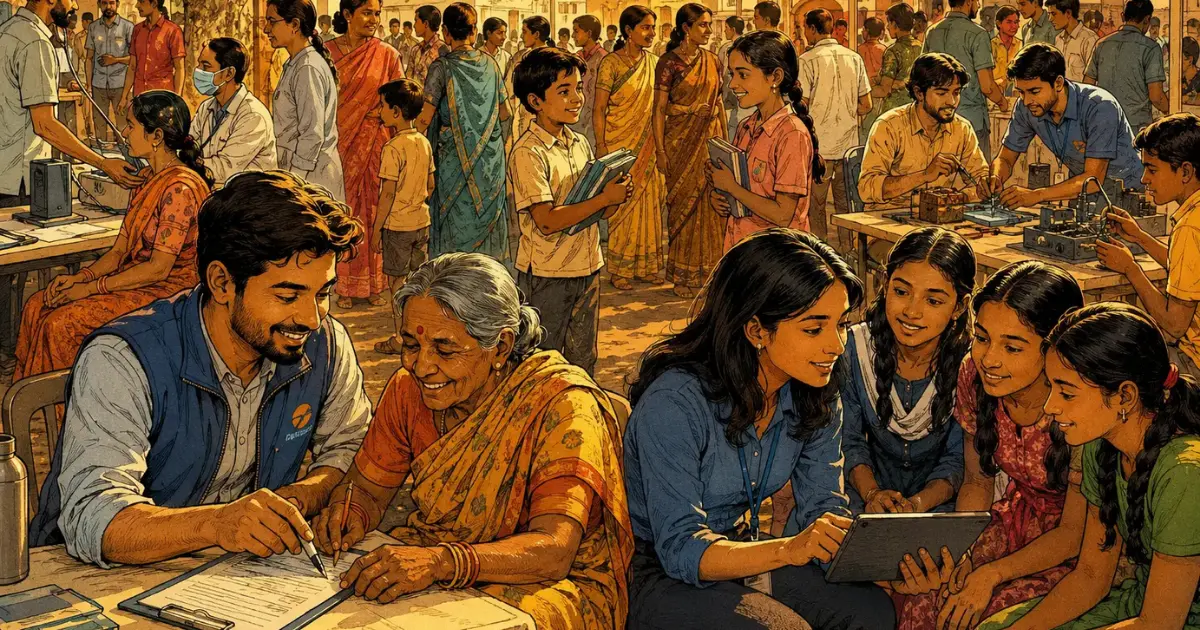
CSR events India are fundamentally different because they are relational. When employees from a corporate team spend a day working alongside children in a school they helped renovate, they are not consuming a message — they are having an experience that will stay with them.
When community members participate in a health camp or skill fair organised through a company’s CSR programme, they are encountering the company in a context of genuine service, not sales. When journalists and stakeholders attend a CSR event where they can see the programme in action and speak to beneficiaries, no amount of press release writing can produce the kind of authenticity that the visit itself generates.
This experiential quality is what makes CSR events India a brand tool of a different order from conventional communications. The brand impression formed through a shared experience is more durable, more trusted, and more likely to be shared than anything a company can produce at its own desk.
The Employee Engagement Dimension
One of the most compelling and underestimated benefits of CSR events India is their impact on employees. Research consistently shows that employee participation in purpose-driven activities has significant effects on engagement, retention, and satisfaction. Employees who participate in purpose programmes are 52% less likely to leave their organisation.
Companies with strong ESG engagement see employee satisfaction scores run 14% higher than bottom-quartile companies. In India, where millennials and Gen Z will make up 65% of the workforce by 2025, demand for purposeful work is not a soft preference — it is a talent market reality.
CSR events that invite employee participation — whether in community outreach, skills training camps, environmental restoration, or school renovation drives — transform employees from spectators of the company’s CSR work into protagonists of it. This shift has profound consequences for how employees relate to their employer.
A marketing manager who has personally worked with school children in a community her company supports does not describe her company’s CSR programme as “we give some money to education.” She describes it as “something I’m part of.” That difference matters enormously for brand advocacy, for internal culture, and for retention.
The most effective CSR events India plans for employee engagement combine meaningful activity (not photo-opportunity tree planting) with clear programme context (employees understand what the programme is trying to achieve and why) and follow-through (the event is part of a sustained programme, not a one-day exercise).
Types of CSR Events India — and What Makes Them Work
The landscape of CSR events India spans a wide range, from large-scale community health camps to intimate skill development workshops, from school renovation drives to multi-stakeholder policy dialogues like those hosted through Samabhavana’s PRISM India platform. The formats that work best share certain design principles, regardless of scale.
Community awareness and health camps are among the most common CSR events in India. When designed well — with qualified medical professionals, referral pathways for follow-up care, locally appropriate health messaging, and genuine community mobilisation — these events can reach thousands of people with services they could not otherwise access.
When designed poorly — as one-day visibility exercises without follow-up — they create temporary engagement but no lasting health impact.
Skill and livelihood fairs connect job-seekers with employers and training providers, often in communities where formal employment opportunities are limited and awareness of available training is low.
These events, when organised with genuine market research (which skills are actually in demand in this geography?) and practical support (transportation, documentation assistance, childcare during the event), can be transformative for individual participants and for the community’s long-term economic trajectory.
School and community infrastructure drives — painting schools, building libraries, setting up computer labs — are popular because they are visual, involving, and produce tangible results. The most effective versions of these events are part of multi-year school partnership programmes, not isolated improvement days.
The school looks better after a paint drive, but children learn better after sustained curriculum support.
Multi-stakeholder dialogues — bringing together companies, government officials, NGOs, and community representatives to discuss shared challenges — produce impact of a different kind. These conversations change how decisions are made, not just what resources are deployed.
Samabhavana’s PRISM platform, described in more detail at samabhavana.in/prism.html, is India’s longest-running example of this format.
The Line Between Impactful and Performative – CSR events India
The Indian CSR events space has a problem that practitioners know well and discuss frankly: a significant proportion of events are designed primarily for visibility rather than impact. The tell-tale signs are familiar.
A large banner prominently displaying the corporate sponsor’s logo at a community event that serves more as a photo backdrop than as context for genuine service.
A health camp where beneficiaries are herded through cursory check-ups without referral pathways for those who need follow-up care. A school visit where children perform for visiting executives rather than receiving meaningful educational engagement.
These events are, at best, wasted money. At worst, they create a community expectation of corporate engagement that is then disappointed by the absence of follow-through — eroding trust rather than building it.
The difference between impactful and performative CSR events lies in intent and design. Does the event serve a genuine community need, identified through consultation with the community?
Is it part of a sustained programme rather than a one-off? Are outcomes tracked and reported honestly? Is the community’s experience of the event shaped by what they receive rather than what the sponsor needs for its communications?
Companies that ask these questions consistently produce better events — and better brand reputations. The CSR events India landscape is maturing, and audiences — employees, communities, journalists, and investors — are increasingly capable of distinguishing authentic engagement from brand theatre.
Samabhavana’s Events Experience
Samabhavana has been designing and delivering CSR events and programmes for 25 years. Our experience spans the full range of formats — community health camps, education outreach, skill fairs, women’s empowerment workshops, and multi-stakeholder dialogues.
We bring to every event the community relationships and field knowledge that make the difference between an event that lands and one that misses.
We understand the communities our partners serve because we have been working in them for years — sometimes decades. We know which health concerns are most pressing in which areas, which skill training formats produce employment, which school improvement approaches actually improve learning. This knowledge is not available from a desk; it is built through sustained field presence.
For companies wanting to make their CSR events matter — not just for brand communications but for genuine community impact — our contact page is the right place to start. You can also explore our programme work in education, health, skill development, and women empowerment.
FAQ
Q1: What are CSR events India and how do they differ from traditional corporate events?
CSR events India are community-serving activities organised or funded by companies as part of their CSR programme — including health camps, skill fairs, school outreach drives, and multi-stakeholder dialogues. Unlike traditional corporate events, they are relational and community-focused, creating brand impressions through shared experience rather than one-directional communication.
Q2: How do CSR events India build brand reputation?
CSR events create authentic, experiential encounters between companies and communities. When communities receive genuine service through a well-designed CSR event, the brand impression formed is more durable and trusted than any advertisement. 76% of companies globally recognise CSR as an effective tool for managing brand reputation risk.
Q3: What role do CSR events play in employee engagement?
CSR events that involve employees directly in community service have significant engagement effects. Employees who participate in purpose-driven activities are 52% less likely to leave their organisation, and companies with strong ESG engagement see employee satisfaction scores run 14% higher. Purpose is a key driver for India’s millennial and Gen Z workforce.
Q4: What types of CSR events work best in India?
The most effective formats include community health camps with referral pathways, skill and livelihood fairs with genuine market linkages, school and community infrastructure drives embedded in sustained programmes, and multi-stakeholder dialogues. The unifying factor is design for genuine community impact rather than corporate visibility.
Q5: How can companies tell whether a CSR event is impactful or performative?
Key questions: Was the community consulted in designing the event? Is the event part of a sustained programme or a one-off? Are outcomes tracked? Does the event serve a genuine need the community identified? Impactful events serve communities first; performative ones serve the sponsor’s visibility first.
Q6: How does Samabhavana help companies design high-impact CSR events?
Samabhavana brings 25 years of community relationships, field knowledge, and programme design experience to CSR events. We design events that are embedded in sustained programmes, serve genuine community needs, and produce outcome evidence for BRSR reporting. Contact us to discuss your next CSR event.
CONCLUSION – CSR events India
The shift from compliance CSR to engaged, visible, community-connected CSR is one of the most important strategic moves a company can make in India’s current environment.
CSR events India done right are among the most powerful brand investments available — creating authentic relationships with communities, energising employees, generating compelling ESG evidence, and demonstrating the kind of corporate citizenship that India’s consumers, talent, and investors are increasingly rewarding.
Contact Samabhavana to design CSR events and programmes that do more than look good — that genuinely change what they set out to change.