
STEM Is Not Only for Toppers—It’s for Every Child
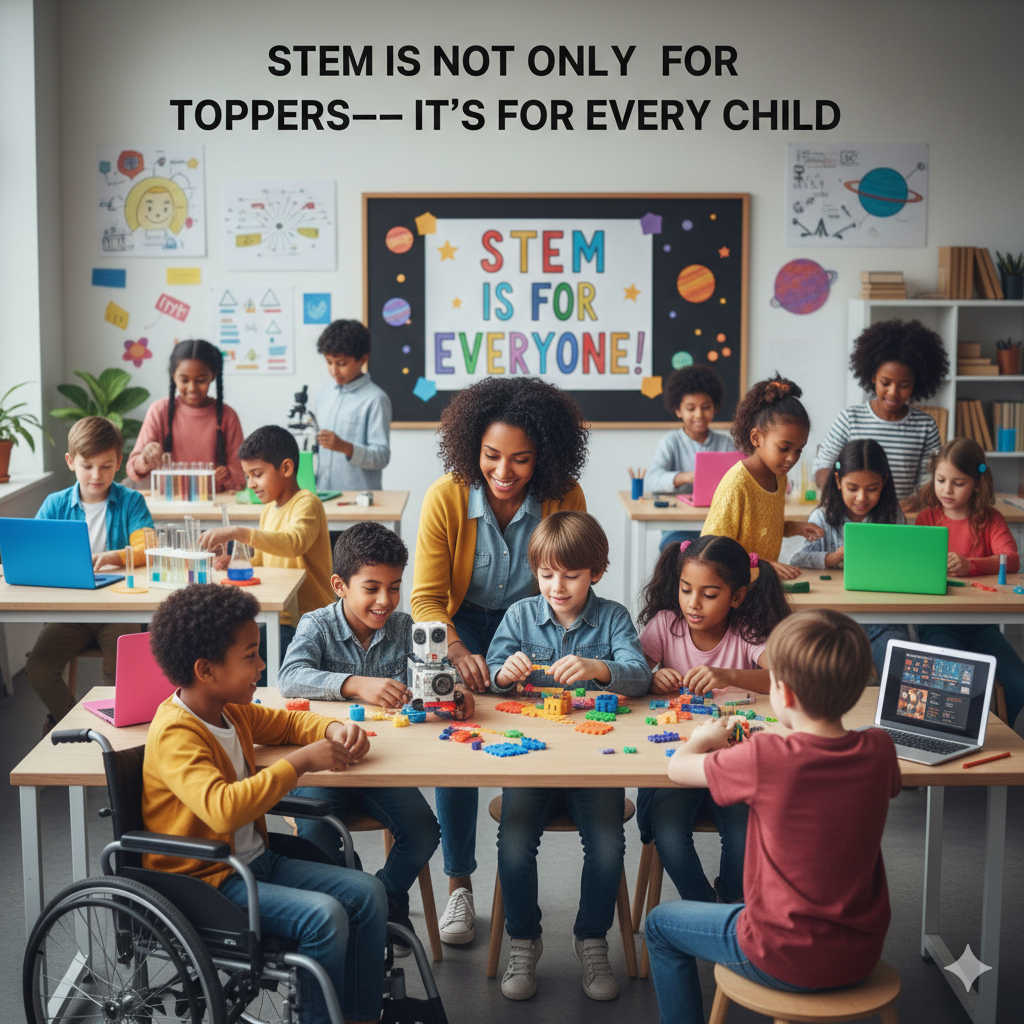
For many years, STEM education has carried an invisible label. It is often seen as something meant only for “bright students,” “toppers,” or children who score high in science and mathematics.
This belief quietly shapes expectations in schools, homes, and even in children’s minds.
Many students begin to think, “STEM is not for me.”
But this idea is not only incorrect — it is harmful.
At Samabhavana, we believe that STEM (Science, Technology, Engineering, and Mathematics) is not about speed, memorization, or marks. It is about curiosity, experimentation, creativity, and problem-solving — qualities that exist in every child.
Understanding What STEM Really Means
STEM is often misunderstood as:
- Solving equations quickly
- Scoring high in exams
- Memorizing formulas
- Competing for top ranks
In reality, STEM is about:
- Asking questions
- Observing patterns
- Testing ideas
- Learning from mistakes
- Working collaboratively
According to the National Education Policy (NEP) 2020, experiential and skill-based learning is essential for developing critical thinking and problem-solving skills in students.
(Source: https://www.education.gov.in/en/nep-2020)
This vision aligns strongly with inclusive STEM education.
The Problem with Labeling Children Early
In many Indian classrooms, academic pressure leads to rigid categorization:
- “Good in studies”
- “Weak in math”
- “Average student”
These labels can deeply affect a child’s self-confidence.
When a child repeatedly hears they are “not good at science,” they begin to believe it.
Over time, this belief becomes a barrier.
Inclusive STEM education challenges this mindset by providing multiple ways to learn and succeed.
How Hands-On STEM Changes Classroom Dynamics
When STEM is taught only through textbooks and exams, many children lose interest.
But something powerful happens when learning becomes experiential.
When children are given:
- Materials to build models
- Experiments to conduct
- Real-world problems to solve
- Group projects to collaborate on
Students who may struggle in written exams often shine.
A child who cannot memorize formulas may still design a working model.
A quiet student may lead during construction or testing.
Teachers frequently observe that participation increases dramatically when STEM is hands-on.
Learning becomes inclusive rather than selective.
STEM Is About Process, Not Perfection
One of the most important lessons STEM teaches is this:
Mistakes are part of learning.
When a model fails, children learn why.
When an experiment doesn’t work, they try again.
This process builds:
- Patience
- Resilience
- Critical thinking
- Adaptability
According to research by the OECD on 21st-century skills, problem-solving and resilience are key competencies for future-ready learners.
(Source: https://www.oecd.org/education/)
These qualities matter far more than speed or perfection.
STEM in Government and Low-Resource Schools
In many government and low-resource schools, children have limited access to hands-on learning.
When STEM is introduced through practical activities:
- Students become more confident
- Learning feels real, not abstract
- Curiosity replaces fear
Children begin to see that knowledge is not confined to textbooks.
At Samabhavana, initiatives focus on experiential education that builds confidence alongside academic understanding.
👉 Learn more about Samabhavana’s education initiatives:
https://samabhavana.in/
Changing Parental Perceptions About STEM
Many parents believe that only academically strong children should pursue STEM subjects.
If a child struggles with grades, parents may unintentionally discourage participation in science-related activities.
This narrows potential.
When parents understand that STEM also develops:
- Creativity
- Logical thinking
- Collaboration
- Practical life skills
They begin to see it as growth-oriented rather than competition-driven.
STEM becomes about development — not comparison.
Girls and Marginalized Children in STEM
Inclusive STEM education plays a powerful role in promoting equality.
When classrooms encourage participation from:
- Girls
- First-generation learners
- Children from marginalized communities
Barriers begin to break.
Representation and encouragement allow children to imagine possibilities they may not have considered before.
The United Nations Sustainable Development Goals (SDG 4 & SDG 5) emphasize inclusive quality education and gender equality as pillars of sustainable development.
(Source: https://sdgs.un.org/goals)
Inclusive STEM education supports both.
Assessment Beyond Written Exams
One major reason STEM feels exclusive is how it is assessed.
If learning is measured only through written tests, many capable children are left behind.
Balanced evaluation methods include:
- Project-based assessment
- Observation
- Participation
- Problem-solving ability
- Creativity
This approach does not lower standards.
It broadens access.
STEM Connects to Everyday Life
Children use STEM thinking daily when they:
- Fix broken objects
- Recognize patterns
- Estimate measurements
- Solve small household problems
When they understand that STEM is part of everyday life, they begin to see themselves as capable thinkers.
STEM stops feeling distant.
It becomes relatable.
The Real Goal of STEM Education
STEM education is not about producing only engineers or scientists.
It is about creating:
- Thinkers
- Innovators
- Problem-solvers
- Confident learners
When children explore without fear of failure, learning becomes meaningful.
When curiosity is valued over correctness, participation increases.
When every child feels included, education becomes powerful.
Conclusion: STEM Belongs in Every Classroom
STEM should not be reserved for toppers.
It should not be limited to high scorers.
It should not be restricted by labels.
STEM belongs in every classroom — and to every child.
When learning is inclusive, hands-on, and supportive:
- Confidence grows
- Curiosity deepens
- Participation improves
- Potential expands
At Samabhavana, the belief remains clear:
Every child has the ability to think, question, and create.
And when every child feels included in STEM, true learning begins.