
From Token Gestures to Transformation: CSR Activities Results India Can Be Proud Of
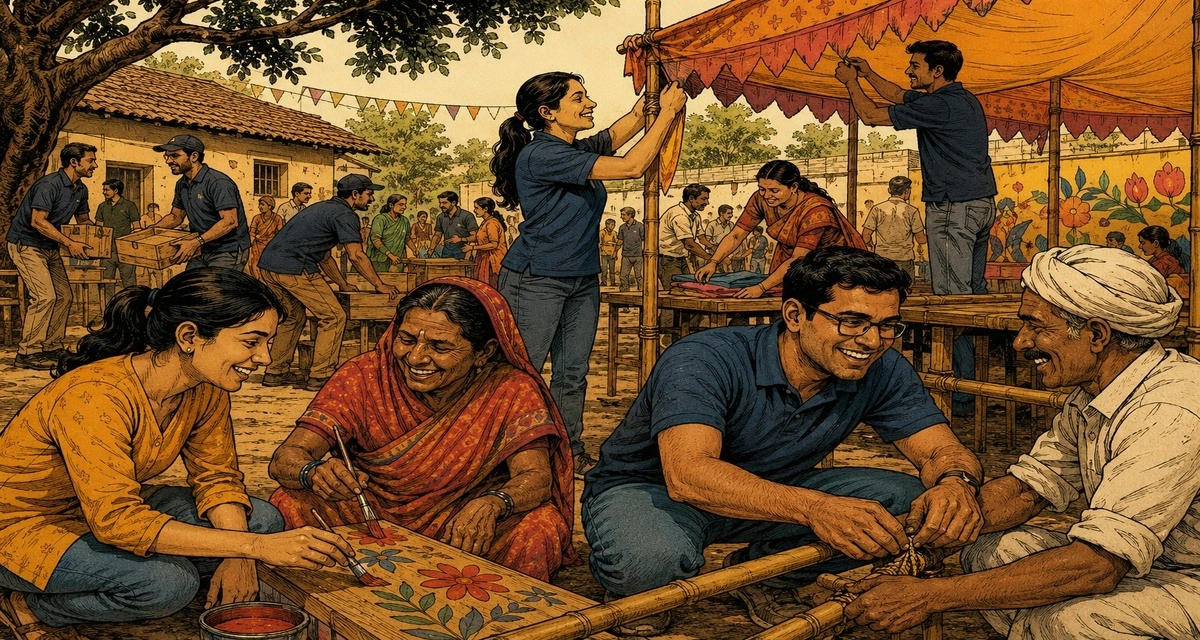
India spends more than ₹34,900 crore per year on corporate social responsibility. That is a significant sum — enough, in theory, to meaningfully accelerate progress on education, health, women’s empowerment, and dozens of other challenges that hold communities back.
In practice, However, CSR activities results India actually sees are often far below what is possible. Not because of bad intentions, but because of bad design: short-term programmes that cannot produce lasting change, output-focused reporting that counts beneficiaries without measuring benefit, and implementing partnerships selected on convenience rather than capability.
This gap between CSR spend and CSR impact is the central challenge facing India’s corporate responsibility ecosystem in 2026. And it is a gap that the right design, the right measurement approach, and the right NGO partner can close — not completely, but significantly.
Understanding what separates tokenistic CSR from transformative CSR is essential for any company serious about making its social investment count.
What Tokenistic CSR Looks Like
Tokenistic CSR is recognisable by its design signatures. It tends to be short in duration — single events, annual donations, one-time infrastructure installations — because short-term commitments are easier to plan, approve, and budget. It tends to focus on visible outputs — number of beneficiaries, number of events, number of items donated — because these are easy to count and easy to report. It tends to avoid communities with complex or sensitive needs — the severely disadvantaged, the geographically remote, the socially marginalised — because these require more effort and longer timelines.
The irony of tokenistic CSR is that it often does not even serve its stated purpose of brand benefit. Sophisticated stakeholders — ESG investors, BRSR reviewers, Informed Journalists, Community Members who have seen corporate teams arrive and disappear — can identify the difference between genuine commitment and performance. BRSR’s mandatory outcome disclosures are making it progressively harder to package tokenistic activity as genuine impact.
There is also an opportunity cost. Every rupee spent on a one-day health camp that treats 200 people and follows up with none of them is a rupee not spent on a sustained community health worker programme that changes the health trajectory of 500 households over three years. The difference in social return on investment between these two approaches is not incremental — it is transformational.
What CSR Activities Results India Really Looks Like
The best CSR activities results India has documented share a common architecture. They are built on long-term community presence — not parachuted in from outside but delivered by organisations with existing relationships in the community, understanding of its specific context, and trust built over years of consistent engagement. They are designed around clearly defined outcomes — not “we will train 500 women” but “we will increase the income of 500 women by 30% over three years through skill development linked to specific market opportunities.
” They are measured honestly — using pre- and post-assessment tools, third-party verification where appropriate, and willingness to report on what did not work as well as what did.
Long-term results take time to appear — which is why multi-year CSR commitments are not just nice to have, they are essential for producing the kind of change that BRSR now asks companies to document. A three-year education programme that consistently raises learning levels in a target set of schools is something a company can report with pride and evidence.
A series of annual school donations that have no measurable effect on learning is something that looks increasingly thin under BRSR scrutiny.
Education: Moving from Infrastructure to Outcomes
In education CSR, the shift from tokenism to impact means moving from infrastructure donation to learning outcome improvement. India’s CSR ecosystem has funded thousands of school building renovations, computer lab installations, and library set-ups.
Many of these have been genuinely useful. But the most impactful education CSR combines physical improvement with the human dimensions — teacher training, curriculum support, student assessment, and the kind of sustained engagement that allows a school to keep improving after the project formally ends.
Samabhavana’s approach to education CSR, detailed on our education page, prioritises learning outcomes from programme design through to reporting.
Health: Moving from Access Events to Health System Strengthening
In health CSR, the shift from tokenism to impact means moving from health camps — which are access events, not health system interventions — to health system strengthening that changes how communities receive and respond to health services over the long term.
A well-designed health camp is a useful entry point: it brings people into contact with health services, diagnoses conditions that would otherwise go undetected, and — if properly designed — creates referral pathways for those who need ongoing care.
But the health camp that sends 200 people home with a printout of their blood pressure reading and no follow-up pathway has done very little to improve their health. The health worker programme that supports 50 ASHAs over three years — training them to identify, counsel, and refer patients with chronic conditions — changes the health trajectory of thousands of people, continuously, without requiring a corporate team to show up annually for photographs.
Schedule VII explicitly includes health and preventive healthcare as CSR categories. The most impactful health CSR in 2026 is health system strengthening: investing in the human and institutional infrastructure that makes community health work year-round, not just on event days. Learn more about Samabhavana’s health programmes here.
Skill Development: Moving from Training to Employment
In skill development CSR, the shift from tokenism to impact means moving from training completion to employment. India runs some of the world’s largest skill training programmes, and completion rates are reasonably high. Employment rates after training — particularly in sectors and geographies where training does not match labour demand — are much lower.
A skill training programme that certifies 200 people but places 40 in jobs is not a success; it is an expensive output without meaningful outcome.
High-impact skill development CSR is designed around employer demand, not just training supply. It starts with mapping actual job opportunities in the target geography, designs training accordingly, provides job readiness support (communication skills, workplace behaviour, documentation), and maintains placement tracking and support for three to six months after training ends.
This design is more complex and more expensive per beneficiary than generic training — but it produces employment, which is the only outcome that matters.
Explore Samabhavana’s skill development work here.
Choosing the Right NGO Partner for Outcome-Driven CSR
The implementing partner is the single most important variable in CSR outcomes. The right NGO partner brings community relationships built over years, trained staff who understand the programme’s theory of change and can deliver it consistently, monitoring systems that capture the data needed for outcome reporting, and the intellectual honesty to tell a corporate partner when something is not working and needs to change.
Questions every CSR committee should ask a prospective NGO partner:
- How long have you worked in this community? What outcomes have your past programmes achieved, and how do you know?
- What does your monitoring and evaluation system look like?
- How have you adapted when a programme did not produce the expected results?
- These questions separate experienced, outcome-oriented partners from organisations that are good at proposals but variable in delivery.
Samabhavana has 25 years of programme delivery experience across Maharashtra and beyond — in education, health, skill development, women empowerment, and diversity and inclusion. Our PSU and donor partners page reflects the kind of long-term, outcome-focused partnerships we build.
FAQ – CSR Activities Results India
Q1: Why do CSR activities results India often fall short of expectations?
Most underperforming CSR programmes share common design flaws: short timeframes that cannot produce lasting change, output-focused measurement that counts beneficiaries without measuring benefit, lack of community consultation in design, and implementing partners selected for convenience rather than capability.
Q2: What is the difference between output and outcome in CSR measurement?
An output is what a programme does (trained 200 women, built 5 classrooms, ran 10 health camps). An outcome is what changes as a result (income increased by 25%, reading levels improved by one grade, maternal mortality reduced by 30%). BRSR reporting is increasingly focused on outcomes, not just outputs.
Q3: How long should a CSR programme run to produce real impact?
Most meaningful social change requires at least three years of sustained investment. Education programmes need multiple school years to show learning improvements. Health behaviour change takes 18–24 months of sustained community engagement.
Skill development with employment outcomes needs market linkage time. Multi-year commitments are the single best indicator of a serious CSR programme.
Q4: How does Schedule VII relate to outcome-driven CSR?
Schedule VII defines the eligible categories for CSR spending under the Companies Act 2013. Being Schedule VII-aligned is a necessary condition for CSR eligibility but not a sufficient condition for impact.
Genuine impact requires good design, capable implementation, and honest measurement within the relevant Schedule VII category.
Q5: What should a company look for in a CSR impact report from an NGO?
Look for: pre- and post-assessment data; specific outcome indicators (not just beneficiary counts); honest discussion of what did not work; third-party verification; and documentation of how outcomes will be sustained after the project ends.
A good impact report answers “so what?” not just “how much.”
Q6: How does Samabhavana ensure CSR activities produce real results?
Samabhavana builds outcome measurement into programme design from the start — establishing baselines, defining target outcomes, and tracking progress throughout delivery. We work with corporate partners on multi-year programmes and provide BRSR-ready impact reports that document real change, not just activity.
Contact us to discuss outcome-driven CSR.
CONCLUSION – CSR activities results India
India’s CSR ecosystem is mature enough to know the difference between tokenism and transformation. BRSR reporting is making that difference visible. Communities are expressing it through the trust (or lack of it) they extend to corporate partners. Employees are feeling it through their sense of pride (or embarrassment) in their employer’s social commitment.
The standard for CSR activities results India deserves — transformative, documented, sustained — is not impossible to meet. It requires better design, longer commitments, and the right partners.
Contact Samabhavana to build a CSR programme that produces the results India needs — and that you can report with genuine pride.