
Sky Lessons: What Stars and Planets Teach Children About Patience and Hope
In today’s fast-moving digital world, children are surrounded by instant results. Videos load in seconds, messages arrive immediately, and answers appear with a single tap. While technology has made learning more accessible, it has reduced opportunities for children to slow down, observe carefully, and wait patiently.
Patience — one of the most important life skills — is gradually disappearing from daily routines.
Astronomy gently brings it back.
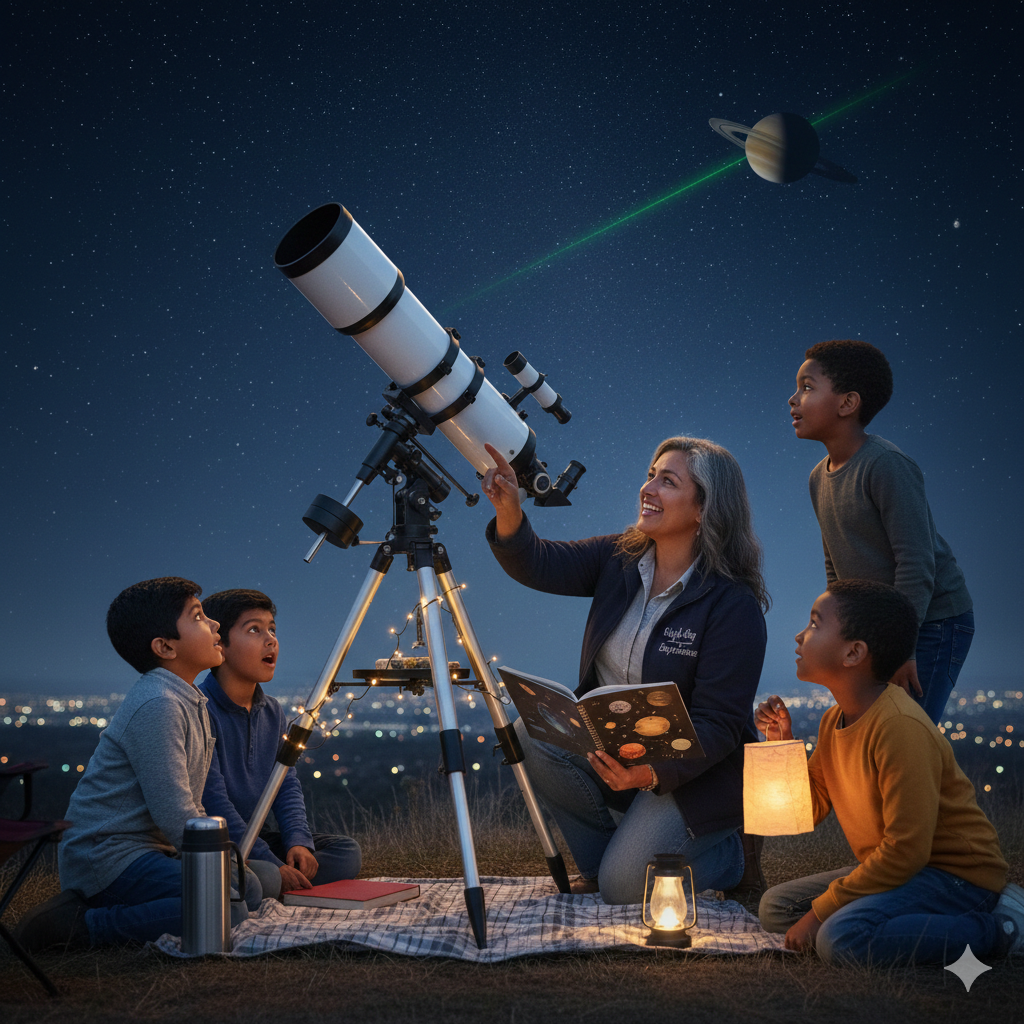
Through meaningful initiatives like the Smile Hub Programme, Samabhavana introduces children to astronomy in simple, engaging, and accessible ways. Sky observation sessions, solar system activities, and interactive discussions encourage children to explore the universe with curiosity, calmness, and reflection.
How Astronomy Teaches Patience in Children
Learning That Nature Follows Its Own Rhythm
When children begin learning about stars, planets, and the solar system, they quickly notice something different from regular classroom lessons.
There is no rush.
There are no instant answers.
Instead, they are encouraged to observe patterns over time.
- Watching the sun’s movement across the sky
- Understanding why the moon changes its phases
- Learning how planets orbit the sun
Astronomy teaches that everything unfolds gradually.
According to NASA’s Solar System Exploration Program, planetary motion and lunar cycles help children understand long-term patterns and scientific observation.
(Source: https://solarsystem.nasa.gov)
This process introduces an important life lesson:
Some things take time to understand.
Discovering That Growth Happens Step by Step
When children learn that:
- Earth takes one year to orbit the sun
- Some planets take many years to complete their journey
- Stars form over millions of years
They begin to understand long timelines.
In a world focused on quick results, astronomy shows that meaningful progress is slow but steady.
Just as planets move patiently in space, children also grow gradually — emotionally, intellectually, and personally.
At Samabhavana’s Smile Hub centres, educators observe that astronomy sessions create a calm and focused environment. Even restless children become thoughtful observers.
This improves:
- Attention span
- Emotional balance
- Deep thinking skills
Astronomy as a Source of Hope
The Power of Distant Light
One of the most powerful lessons astronomy offers is hope.
When children learn that the light from stars takes years — sometimes millions of years — to reach Earth, they are amazed.
Something far away can still shine brightly and reach us.
This idea connects deeply with children’s lives.
Many children face:
- Academic pressure
- Financial challenges
- Social uncertainty
Astronomy may not solve these problems directly, but it provides perspective.
Looking at the vast universe reminds children that life is bigger than immediate worries.
According to UNESCO’s science education framework, inquiry-based science learning strengthens resilience and long-term thinking.
(Source: https://www.unesco.org/en/education/science-technology)
Learning Consistency from the Sky
The sky teaches reliability:
- The sun rises every morning
- The moon follows predictable phases
- Seasons change gradually
For children who feel anxious about change, these natural patterns provide comfort and reassurance.
Astronomy shows that the universe has order and rhythm.
This builds emotional stability and resilience.
Building Curiosity Beyond Textbooks
Astronomy naturally inspires deeper questions:
- Why are some stars brighter than others?
- Why does the moon sometimes look full and sometimes thin?
- How far away are the planets?
Rather than giving quick answers, facilitators at Samabhavana encourage children to observe and think.
This strengthens:
- Critical thinking
- Scientific curiosity
- Independent reasoning
👉 Learn more about Samabhavana’s child development initiatives:
https://samabhavana.in/
Creating a Stress-Free Learning Environment
Unlike competitive academic subjects, astronomy:
- Does not reward speed
- Does not pressure for immediate answers
- Encourages calm observation
Children who may struggle in traditional classrooms often find joy in astronomy-based learning.
It values curiosity over competition.
Schools that include regular astronomy activities often report:
- Better concentration
- Improved listening skills
- Increased classroom engagement
Connecting Culture and Science
Indian culture has long connected stories with the sky — about the sun, moon, constellations, and planets.
Samabhavana blends these cultural narratives with scientific explanations, making astronomy education more relatable and meaningful.
Children begin to see that science is not distant or foreign.
It is part of their heritage and shared human experience.
Teaching Humility and Perspective
When children understand the vastness of the universe, they feel connected to something greater.
This fosters:
- Respect for nature
- Appreciation for time
- A sense of unity
In a diverse country like India, the sky is something everyone shares.
Children from villages, towns, and cities all look up at the same stars.
This shared experience creates inclusion and belonging.
Simple Tools, Powerful Impact
Astronomy education does not require expensive laboratories.
All it needs is:
- Simple sky observation
- Basic models
- Guided discussions
- Encouragement to ask questions
Through the Smile Hub Programme, Samabhavana ensures astronomy learning reaches children from all backgrounds — making science accessible and inspiring.
Conclusion: The Universe as a Teacher of Patience and Hope
Astronomy teaches children that not everything valuable happens quickly.
Some things require:
- Time
- Focus
- Observation
- Steady effort
Just as planets slowly travel around the sun, children grow at their own pace — learning, improving, and shining in their own time.
Through astronomy education, Samabhavana continues to nurture patience, curiosity, resilience, and hope in young minds.
Because sometimes, the most powerful lessons do not come from textbooks.
They come from looking up at the sky.