
10 High-Impact CSR Activities for Companies in 2026
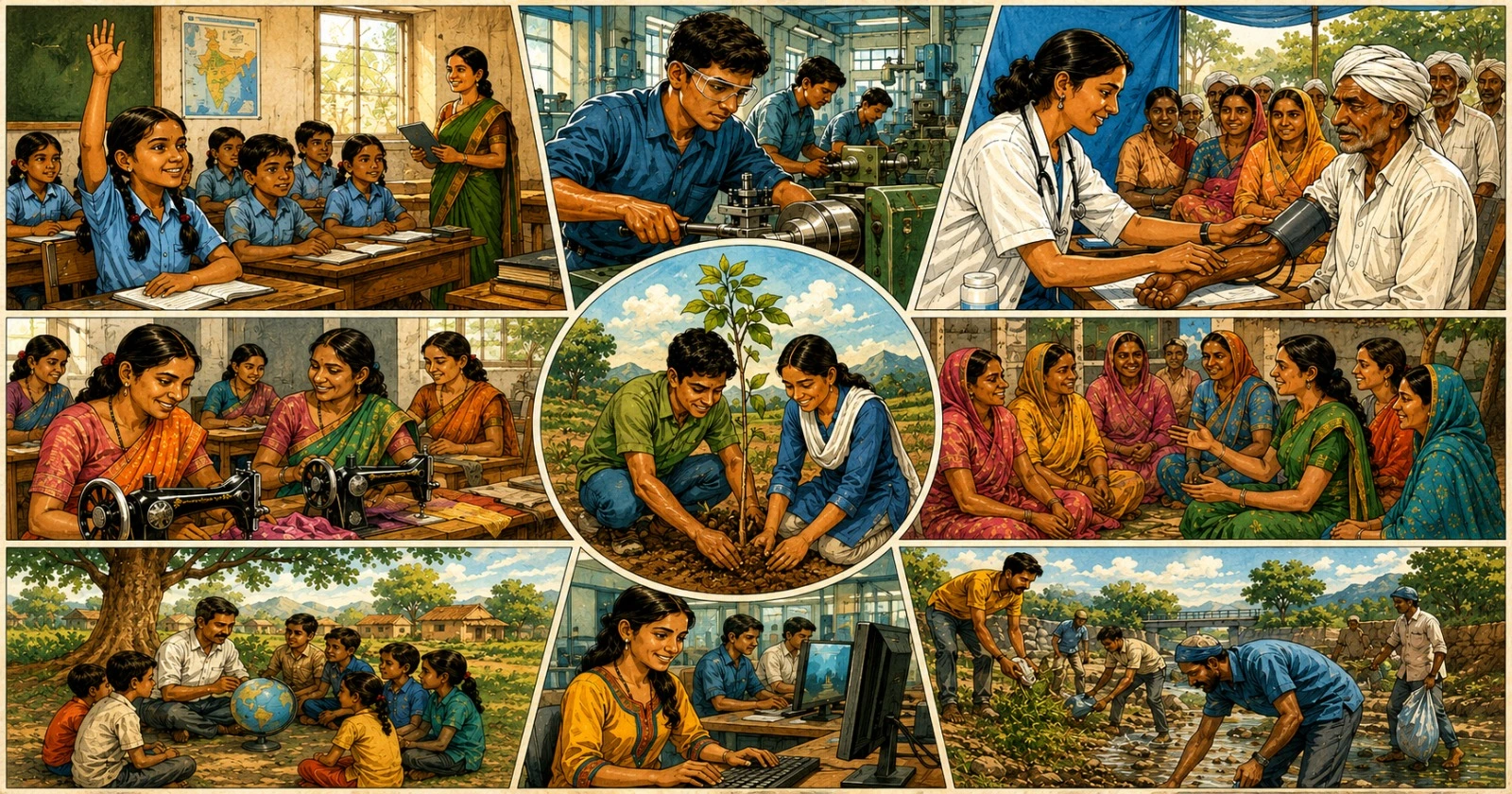
If your company is finalising its CSR programme for 2026, the starting point is not a list of causes that sound good — it is a clear-eyed assessment of where your investment can create durable, measurable change that aligns with Schedule VII requirements and holds up under BRSR scrutiny.
CSR activities India 2026 need to meet a higher bar than they did five years ago. Regulators expect outcome reporting. Investors expect ESG evidence. Employees expect authenticity. And communities deserve programmes that actually work.
Choosing the right CSR activities India 2026 is a strategic decision — one that requires understanding both the national development context and the specific capacity of your implementing partner to deliver.
This guide covers ten areas of proven high impact, with the data and design principles that make each one count.
1. Education: Digital Classrooms and Teacher Training
Education is India’s largest CSR category by spend, receiving approximately 37% of total CSR funds in FY 2023–24.
Under Schedule VII, Education and Vocational Skills Development are explicitly eligible activities. For 2026, the highest-impact education CSR is the combination of digital infrastructure with teacher capability development — because hardware without training produces storage rooms, not learning.
CSR programmes that mirror this integrated approach — providing technology, training, and curriculum support as a package, not as separate line items — produce the learning improvements that can be measured, reported, and built upon.
For companies in manufacturing, technology, or financial services, education CSR in government schools serving first-generation learners offers both strong community impact and compelling BRSR evidence.
Explore Samabhavana’s education programmes here.
2. Healthcare: Mobile Health Units and Community Health Workers
Healthcare receives the second-largest share of CSR funds and is explicitly listed in Schedule VII.
For 2026, the highest-impact Healthcare CSR combines reach (mobile health units that bring services to communities without facility access) with depth (training and supervising community health workers who provide ongoing care between visits).
India has approximately 1.3 million Accredited Social Health Activists (ASHAs) who form the backbone of the public health system’s last mile. CSR programmes that strengthen this infrastructure — through training, equipment, incentives, and supervision — multiply the impact of government investment rather than duplicating it.
Health camps are popular, but they are most effective when embedded in a programme that ensures follow-up care for the conditions diagnosed.
Samabhavana’s Health Work is described on our health page.
3. Skill Development and Vocational Training – CSR activities India 2026
Schedule VII includes vocational skills and livelihood enhancement as eligible CSR categories.
India trains approximately 10 million people per year through the Pradhan Mantri Kaushal Vikas Yojana (PMKVY) and related schemes — but the quality and labour market alignment of this training varies enormously.
CSR-funded skill development programmes that identify genuine employer demand, design training accordingly, and support job placement create measurable economic outcomes: higher incomes, formal employment, and reduced vulnerability.
The most effective skill development CSR programmes are sector-specific and geography-specific.
- Training for solar technicians in states with high renewable energy deployment,
- Training for healthcare support workers in areas with medical infrastructure gaps,
- Training for logistics workers near growing e-commerce hubs — these programmes align
- Training supply with actual labour demand in ways that generic vocational courses cannot.
Explore Samabhavana’s skill development work here.
4. Women’s Empowerment: Economic and Social
Gender equality and women’s empowerment is a dedicated Schedule VII category, and 2026 CSR planning should treat it as a priority that cuts across other areas, not just a standalone programme.
- Women’s economic empowerment through self-help group linkages, entrepreneurship development, and financial literacy can double household incomes.
- Women’s social empowerment through education, health access, and safety programmes changes the life trajectories of the next generation, not just the current one.
India has approximately 12 million self-help groups with over 14 crore members — the world’s largest network of women’s microfinance and peer support.
CSR programmes that strengthen these networks through skills training, market linkages, and financial inclusion create multiplier effects that far exceed the value of one-time cash transfers or awareness campaigns.
Samabhavana’s women empowerment page describes our programmes in detail.
5. Environmental Sustainability
Environmental sustainability is explicitly included in Schedule VII and is growing rapidly as a CSR priority, driven by both regulatory pressure (BRSR’s environmental disclosures) and genuine corporate awareness of climate risk.
High-impact environmental CSR in 2026 includes watershed development and water conservation in drought-prone districts, solid waste management in urban and peri-urban communities, clean energy transitions for rural households and institutions, and biodiversity conservation linked to the company’s operational footprint.
The key design principle for environmental CSR is community integration: environmental interventions that are done with communities rather than to them produce better environmental outcomes and generate the social acceptance that allows programmes to sustain beyond the project period.
6. Digital Literacy
Among the CSR activities India 2026 that are fastest-growing, digital literacy stands out. India’s digital economy is expanding at remarkable speed, but access to the skills needed to participate is deeply unequal. Rural communities, women, older adults, and informal sector workers are disproportionately excluded from the economic benefits of digitisation.
CSR-funded digital literacy programmes that teach practical skills — using UPI for transactions, accessing government services online, using smartphones for business communications — create lasting economic value.
Programmes that go beyond teaching people to operate devices (basic use) to teaching them to use digital tools for economic activity (applied use) produce the income and empowerment gains that justify the investment.
7. Mental Health
Mental health is a Schedule VII-eligible healthcare CSR activity and one of the most underfunded areas in India’s social sector. With 197 million people living with mental health conditions and more than 80% receiving no treatment, the need is enormous.
For 2026, high-impact mental health CSR combines community awareness (reducing stigma), frontline worker training (ASHAs, teachers, and community leaders who can identify distress and make referrals), and access support (counselling services in schools and community centres).
Workplace mental health programmes that support employees are also Schedule VII-eligible as Healthcare CSR, and their business case is direct: better employee mental health produces higher productivity, lower absenteeism, and stronger retention.
8. Rural Development – CSR Activities India 2026
Rural development is a Schedule VII category that encompasses a wide range of activities: road connectivity, drinking water, sanitation, livelihood diversification, and community infrastructure. India’s 640,000+ villages remain highly varied in development status.
CSR rural development programmes that identify genuine infrastructure and economic gaps in specific geographies and address them in co-ordination with panchayat and block-level government produce durable improvements.
9. Sports and Physical Education
Sports is a Schedule VII category that is frequently under-utilised by CSR planners who are not sure how to design a sports programme that creates genuine impact.
High-impact sports CSR goes beyond building a football pitch — it includes trained coaches, regular programming, tournament pathways, and connections to talent identification systems.
Sports programmes in schools and communities that are sustained over years produce outcomes in physical health, mental wellbeing, teamwork, and leadership that are well-documented.
India’s performance in recent international sports competitions has generated significant momentum for grassroots sports investment.
CSR programmes that align with national sports federations or state sports authority schemes can access talent identification infrastructure that amplifies the impact of field-level investment.
10. Diversity and Inclusion
Diversity and inclusion as a CSR activity moves in two directions: internal (creating genuinely inclusive workplaces) and external (supporting marginalised communities through education, economic opportunity, and rights-based advocacy).
Both are eligible under relevant Schedule VII categories, and both are increasingly important for BRSR reporting, which includes specific diversity and inclusion indicators.
External D&I CSR includes programmes for people with disabilities, LGBTQ+ awareness and inclusion, tribal community development, and minority community empowerment.
Internal D&I CSR — training, policy reform, leadership commitment — is not directly a CSR expenditure but creates the cultural context in which external community programmes are designed and delivered with genuine sensitivity.
Samabhavana’s work on diversity and inclusivity spans both dimensions, and we are well-placed to support companies navigating this area thoughtfully.
FAQ – CSR Activities India 2026
Q1: What are the top CSR activities India 2026 for maximum impact?
The ten highest-impact CSR activities for India in 2026 are: education (digital classrooms + teacher training), healthcare (mobile units + community health workers), skill development, women’s empowerment, environmental sustainability, digital literacy, mental health, rural development, sports, and diversity and inclusion.
All are aligned with Schedule VII of the Companies Act 2013.
Q2: How do I choose the right CSR activity for my company’s 2026 programme?
Start with geography (where does your company operate?), sector alignment (what needs relate to your business?), and community consultation (what do the communities actually need?). Then assess your implementing partner’s capability to deliver in that area.
The best CSR programmes align community need, business relevance, and implementation capacity.
Q3: Which CSR activities qualify under Schedule VII?
Schedule VII covers education, health, environmental sustainability, women’s empowerment, poverty eradication, national heritage, rural development, sports, armed forces welfare, and technology incubation.
Most high-impact CSR activities can be mapped to one or more Schedule VII categories.
Q4: Why does education receive the most CSR funding in India? Education accounts for approximately 37% of India’s total CSR spend because it is a clear Schedule VII priority, its need is universal and visible, and it produces outcomes that are meaningful to both communities and companies.
Education CSR is also relatively easy to implement at scale through established NGO networks.
Q5: How should CSR activities be measured for BRSR reporting?
BRSR reporting requires both qualitative (programme descriptions, theory of change) and quantitative (beneficiary numbers, outcome indicators) disclosure.
High-quality BRSR CSR reporting includes pre- and post-assessment data, third-party verification where possible, and honest reporting of what worked and what did not.
Q6: How does Samabhavana help companies implement high-impact CSR activities?
Samabhavana provides end-to-end CSR implementation across all ten activity areas — from needs assessment and programme design to field delivery, outcome measurement, and BRSR-ready impact reporting.
With 25 years of experience across Maharashtra and India, we are one of the country’s most credible CSR implementation partners. Contact us to plan your 2026 programme.
CONCLUSION – CSR Activities India 2026
These 10 CSR activities India 2026 represent the full range of Schedule VII opportunity — from education and health to digital literacy, mental health, and diversity.
Each one, when designed with rigour and implemented by the right partner, can produce outcomes that your company, your communities, and your investors will value.
The companies that will look back on 2026 as a landmark year for their CSR impact are the ones that start planning now — with the right partners, the right design, and the right commitment to outcomes over optics.
Contact Samabhavana to begin planning your 2026 CSR programme with India’s most experienced and credible implementation partner.